How to Rank Higher on Google Maps, in Priority Order
Most Maps guides hand you eleven steps and pretend they all move. Four of the twelve strongest factors cannot be moved at all. Here is the list sorted by what you control and how good the evidence is.

- Four of the top twelve Google Maps ranking factors in Whitespark's 2026 expert survey are decided by where your address is and where the searcher is standing. You cannot optimize any of them.
- Your Maps rank is not one number. Because proximity is the second strongest factor, you have a different rank at every point on the map, which is why a geogrid is the only honest scoreboard.
- The four highest-value controllable levers are primary category, review velocity, accurate hours, and showing a real address. Everything else is a distant second.
- Google Posts rank #148 out of 187 factors and Q&A ranks #142, yet they are the two things most GBP retainers bill for every month.
- Sterling Sky tested it directly: the service area you draw on your profile does not affect where you rank. Rank follows your verified address.
Four of the top twelve Maps factors are fixed. Start by admitting that.
Four of the twelve highest-scoring Google Maps ranking factors come down to where your address sits and where the searcher is standing. None of them can be optimized. Sort the list into what you control and what you do not, then work the controllable half in order of evidence strength: primary category, review velocity, accurate hours, visible address.
Whitespark's 2026 Local Search Ranking Factors report asked 47 local search practitioners to score 187 factors from 0 to 5. Read the local pack column and the top of the list is half geography.
| Rank | Factor | Score | Can you move it? |
|---|---|---|---|
| 2 | Proximity of address to the point of search | 225 | No |
| 4 | Physical address in city of search | 213 | Only by moving offices |
| 7 | Address is showing on the profile, not hidden | 176 | Only with a real staffed address |
| 12 | Proximity of address to the centroid | 157 | Only by moving offices |
Google says the same thing in plainer words. Its local ranking help page lists three inputs and one of them is pure geometry: "Distance refers to how far each business is from the customer who's searching." When the searcher does not name a city, Google "uses what it knows about their location."
There is a fifth constraint almost nobody writes about, and it is not about distance from the searcher at all. It is about distance from your competitor.
When two businesses with the same primary category are located within approximately 200 feet of each other, one business will typically be filtered out for certain queries.
If you share a building with a competitor in your exact primary category, part of your ceiling was set by your landlord. That is not a reason to quit. It is a reason to stop rereading a checklist that quietly assumes every line on it is winnable.
Your Maps rank is not a number. It is a map.
Because proximity is the second strongest factor, the question "where do I rank on Google Maps" has no single answer. You rank first from the coffee shop across the street and eleventh from the subdivision four miles north, at the same moment, for the same query.
That is why geogrid tracking exists. A geogrid samples your position from dozens of coordinates across your service footprint and draws the result as a grid of numbers on a map. In his guide to using geogrid rank trackers, Nielsen calls it the first tool he reaches for when troubleshooting, and the visual pattern itself is diagnostic. A grid with random holes in it is usually filtering, not a ranking problem.
Here is the part most guides skip. If you do not have a geogrid before you start, you cannot tell the difference between the four kinds of movement that look identical in a single-point rank check: a real ranking gain, a proximity artifact from checking on your phone at the office, a filter releasing, and Google testing a layout. Buy or run the grid first. Otherwise you will spend three months optimizing against noise. We go deeper on that in how to tell if your SEO agency is working.
How to read any ranking factor list, including this one
Every Maps guide on page one presents its steps as equally true. They are not. There are three tiers of evidence in local search, and the difference between them is the difference between a Saturday well spent and a Saturday wasted.
Tier A, Google confirmed. Google's own documentation names relevance, distance and prominence, states that "More reviews and positive ratings can help your business's local ranking," and its Search Liaison account wrote in December 2023, as Search Engine Journal reported, that "The team tells me we've long used "openness" as part of our local ranking systems, and it recently became a stronger signal for non-navigational queries." Short list. Highest confidence.
Tier B, correlation at scale. Sterling Sky's near-me ranking study captured the top ten local pack results for five service queries across 200 cities and 8,186 businesses. BrightLocal ran a 7x7 grid at 500m spacing across 1,050 business locations to test category counts, and another across 50 locations to test opening hours. These are real datasets with stated methods. They show association, not cause.
Tier C, practitioner consensus. The Whitespark scores used throughout this post come from 47 experienced local SEOs rating 187 factors. That measures consensus among experienced local SEOs, not measured weight, and it is the best available evidence rather than proof. The report's own author says so out loud, which is more than most ranking factor posts manage.
None of the experts have special access to the internal workings of Google's local search algorithm.
Use the tiers as a spending rule. When Tier A and Tier B point at the same lever, that is where the money goes. When only Tier C supports something, do it once and move on. When nothing above Tier C supports it and it costs you every week, stop.
Tier 1: the four things actually worth a Saturday
These four clear the bar. Each one is controllable, each one sits in the top seven of the expert list, and three of the four have Tier A or Tier B support behind them.
1. Primary category (rank #1, score 227)
The highest-scoring factor you can actually change, and it outscores proximity. It is also the only factor on this list you can fix in ninety seconds.
Google's guidelines tell you to "Choose the fewest number of categories it takes to describe your overall core business" and to pick categories that complete the sentence "This business IS a" rather than "this business HAS a." That is deliberately restrictive advice, and it conflicts with what the data shows about secondary categories.
BrightLocal studied 1,050 business locations across seven primary categories. Locations using four additional categories had the best average map ranking at 5.9. Locations using zero additional categories had the worst at 7.6.
The synthesis those two sources point to, which neither states on its own: your primary category is a positioning decision and your secondary categories are a coverage decision, and they are not the same job. Pick the primary that describes the money service, then use secondaries to catch adjacent demand without diluting the primary. Get the full mechanics in choosing Google Business Profile categories.
Change one thing at a time and watch the grid for seven days. Category changes are the fastest-moving lever in local, which also makes them the fastest way to tank yourself.
2. Review velocity, not review count (ranks #6, #9, #11, #14)
Four separate review dimensions sit inside the top fifteen: high numerical ratings at 181, quantity of native reviews with text at 170, recency at 164, and sustained influx over time at 154.
That clustering is the point. It is not one factor, it is four, and three of the four are about pace rather than total.
The number of reviews you've gotten this month matters more than your total number of reviews.
That is the conclusion of the 8,186-business study, and it is independently echoed by a Google Business Profile Product Expert working from a different dataset.
The number of reviews you get a month, and how recent your last review was, often outweigh the total count
Reviews are the single highest-confidence item on this entire page, and the reason is that the ranking evidence and the buying evidence agree. BrightLocal's 2026 consumer survey of 1,002 US adults found 74% of consumers seek reviews written in the last three months, 47% will not use a business with fewer than 20 reviews, and 85% say positive reviews make them more likely to buy. Nothing else on this list gets you rank and conversion from the same dollar.
The same survey found the bottleneck is not customer willingness. 83% of people who were asked to leave a review went on to leave one. The ask is the problem. Building a review request process is the fix.
One caveat with teeth: Sterling Sky's study found reviews containing written text carried a stronger ranking association than star-only ratings. Ask for a sentence, not a tap.
3. Hours, and being open when people search (rank #5, score 189)
This is the cheapest item on the list and the only Tier 1 lever with a direct Google confirmation attached. The Search Liaison statement above is the confirmation, and Sterling Sky flagged it at the time as a new local pack ranking factor. BrightLocal's grid study across 50 locations in 10 categories is the measurement: reports run during opening hours reflected higher local rankings on average, with fast food restaurants improving by 2.4 positions.
You can watch it happen in real time. When your business is open you can be sitting pretty at #1 in the local results, and then 60 minutes before you close you'll start to drop off, and then when you're actually closed you'll be displaced by businesses that are open.
For a trade that sells urgency, this reframes the whole schedule question. Extending hours is not a customer service decision, it is a visibility decision, and the two now share a budget line. That is the argument for a real after-hours answering setup, which we cover in getting more emergency service calls.
Do not fake it. BrightLocal's own researchers cautioned against drastic profile changes on the strength of their findings, and Google's Local Services Ads documentation states plainly that missed calls may negatively affect your responsiveness score, which feeds ad rank. Listing 24 hours and letting it ring is a net loss.
4. Show your address, if you legitimately can (rank #7, score 176)
Hiding your address ranks as the seventh strongest local pack factor when you do not do it. Sterling Sky's 8,186-business study found the same thing from the correlation side: a negative correlation between hiding your address and ranking well in the local pack.
Here is the honest version of this that no listicle prints. Google's representation guidelines require a service area business operating from a residence to hide the address. Google's algorithm, by every public measurement available, then charges you for compliance. Those two facts sit side by side and the industry mostly pretends they do not.
We are not going to tell you to break a guideline you would be suspended for. What we will tell you is this: if you run a real staffed commercial location and you hid your address years ago because a blog post said service businesses should, unhide it. That is a five-minute reversal of a self-inflicted seventh-strongest-factor penalty. And if you genuinely work from home, stop reading city-page advice that assumes you can rank in the next town over, and read why you cannot rank in another city instead.
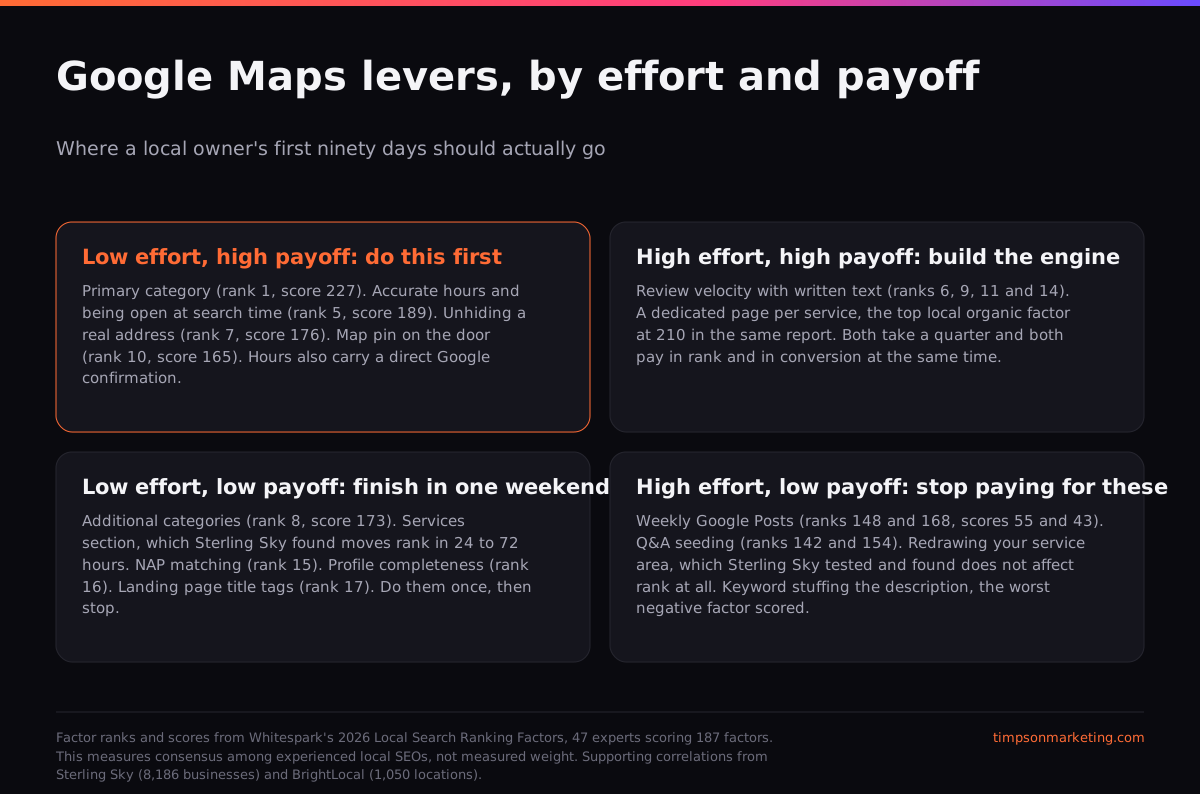
Tier 2: worth one weekend, then leave them alone
Everything here scores between 135 and 173. Real, worth doing, and finishable. None of it justifies a recurring monthly line item.
- Additional categories (#8, score 173). Covered above. Add the ones that genuinely describe what you are, not what you have.
- The Services section. Sterling Sky's testing found that adding services does move rankings, with changes typically showing up within 24 to 72 hours. Worth noting for credibility: this reverses their own 2019 finding that services did nothing. Predefined services score higher in the expert survey (#22) than custom ones (#48), so use Google's list before you write your own.
- Map pin placement (#10, score 165). Drag the pin to your actual door. Verification often drops it on the road or the parcel centroid.
- HTML NAP matching your profile NAP (#15, score 153). Name, address and phone on your site should match the profile character for character.
- Profile completeness (#16, score 147). Fill every field once. Completeness is a threshold, not a dial.
- Landing page title tag and geographic relevance (#17 and #18, scores 146 and 142). The page your profile points at is a ranking input for the profile. A dedicated page per service is the top local organic factor in the same report at 210. See location pages for local SEO for how to build those without creating thin duplicates.
- Removing spam listings (#19, score 137). Reporting fake competitors is a genuine ranking factor. Google routes misleading names, numbers and URLs to the Business Redressal Complaint Form, which accepts ten or more profiles in a single submission.
We do this in a fixed order for every local client, starting with the geogrid baseline and the category audit, because the order is what makes it measurable.
See how we run local→Tier 3: the popular advice the evidence does not support
This is the section that makes owners angry, usually at whoever they were paying last.
Google Posts. Posting frequency ranks #148 of 187 with a score of 55. Post quantity ranks #168 with a score of 43. Both sit near the bottom of a list where the top item scores 227.
Q&A seeding. A comprehensive Q&A section ranks #142 (score 60). Keywords in Q&A rank #154 (score 54). Q&A is a conversion asset. It is not a ranking asset.
The service area you draw on the map. This one was tested directly.
The service area listed in Google Business Profiles (GBP) does not currently impact rankings. Rankings are based on the address used to verify the listing.
Adding forty towns to your service area does not extend your reach by one foot. Google's service area guidelines separately cap that area at "about 2 hours of driving time" from your base, and the expert panel scored an oversized service area as a negative factor. So the tactic does not work and can hurt.
Keyword stuffing your profile description. The expert panel scored eight negative factors. Stuffing the GBP description is the most damaging of all of them, at 21.
Notice what all four of these have in common. They are recurring, they are easy to screenshot, and they fill a monthly report. That is not a coincidence, and it is the main reason local SEO pricing is so hard to compare across proposals.
The awkward one: the third strongest factor breaks Google's rules
Keywords in the business title score 223 and rank third, ahead of everything except your primary category and raw proximity. It works. It is also against the rules.
Google's naming guidelines are explicit that the profile name must be your real-world name as displayed on signage and stationery, and they exclude marketing taglines, business hours, phone numbers, URLs, and location descriptors. "Summit Roofing" is allowed. "Summit Roofing Best Roofer Denver 24/7" is not.
So the third strongest factor on the list is a policy violation with a real suspension risk attached. We do not do it and we do not recommend it. The productive response is the reporting channel: document the offenders in your grid, gather ten or more, and file them through the Business Redressal Complaint Form. Google publishes no success rate or turnaround time for that form, so treat it as a slow lever rather than a fix, and read why a competitor with fewer reviews outranks you before you assume the problem is your own profile.
The pack got smaller in 2026, so ranking higher is worth more and covers less
Two numbers changed the math this year, both from Sterling Sky's State of Local SEO analysis across 322 markets.
Google's AI-powered local packs surfaced 5,943 unique businesses where traditional three-packs surfaced 18,330 across the same markets. Roughly a third as many winners. At the same time, ads inside the local pack went from 1% of tracked reports in early 2025 to 22% by December, and Local Services Ads went from 11% to 31%.
If you have a business profile that ranks really well, even if you don't see a drop in ranking, your calls from the business profile are going down over time.
That is the sentence to sit with. Rank is holding and calls are falling, which means rank was never the product. Calls were.
Meanwhile the discovery channel is splitting. BrightLocal found 45% of consumers have used AI tools to find local business recommendations, up from 6% the prior year. Ranking higher on Maps is still the correct first project for a local service business. It is no longer the whole plan, which is why we pair it with AI visibility work rather than treating them as competing budgets.
The 90 day order of operations
Week 1, baseline
Run a geogrid for your three money keywords before touching anything. Screenshot it. Without this you cannot prove any of the next steps worked.
Week 1, category audit
Check your primary category against the money service and against the top three competitors in the grid. Change one thing. Wait seven days.
Week 2, address and pin
Unhide the address if you have a real staffed location. Drag the pin to the door. Match NAP on your site character for character.
Week 2, hours
Make hours accurate, then decide whether extending them is worth the visibility. Do not list hours you will not answer.
Weeks 3 to 12, review engine
Build one repeatable ask into your job-close process. Aim for steady weekly reviews with written text, never a batch.
Week 4, the finishable list
Services section, additional categories, profile completeness, landing page title tags. One weekend. Then stop touching them.
Ongoing, monthly
Re-run the same grid. Compare against the week 1 screenshot. Track calls, not positions.
That sequence takes a quarter to show clean signal, which matches what we tell every client about how long local SEO takes. If a profile is falling rather than flat, work the ranking drop checklist before starting this list, because you are fixing a different problem.
Every step above has a longer teardown in our Google Maps and the Local Pack library, including the category mechanics, the review scripts, and the city-page trap that eats most of the budget in month two.
One last note on sequencing. Owners almost always want to start with the visible things, because Posts and photos and a rewritten description feel like progress you can see. The evidence says the invisible things move the grid: a category nobody notices, hours nobody reads, an address field you unhide once. Boring order, better results.
What we would ignore entirely
Weekly Google Posts. Seeded Q&A. Redrawing your service area. Buying citations in bulk. Any tool that reports a single Maps rank number. Any agency that promises a map pack position, which Google's own documentation forecloses: "There's no way to request or pay for a better local ranking on Google."
If you want the shorter version: your address already decided part of this, your category decides more of it than anything you can control, your reviews this month matter more than your reviews all-time, and being open when people search is nearly free. Work those, measure with a grid, and ignore the rest of the list until they are done. If you would rather have someone run the sequence for you, that is what we do, and the free visibility audit is where it starts.
Frequently asked questions
How long does it take to rank higher on Google Maps?
Category changes can move a grid within days, and Sterling Sky found service additions typically show within 24 to 72 hours. Review velocity is the slow one, because it depends on job volume. Plan for a quarter before the pattern is clean enough to trust, and always compare against a baseline grid.
Can I rank on Google Maps in a city where I do not have an address?
Not reliably. Physical address in the city of search is the fourth strongest local pack factor in Whitespark's 2026 expert survey, and Sterling Sky tested the service area setting directly and found it does not affect rank. Rank follows the address you verified with, not the towns you list.
Do Google Business Profile posts help Maps rankings?
The evidence says barely. Posting frequency ranks 148th and post quantity ranks 168th out of 187 factors scored by 47 local search experts. Posts can still support conversion once someone is looking at your profile. They are a poor use of a recurring monthly retainer hour.
How many reviews do I need to rank in the map pack?
There is no confirmed threshold. What the evidence supports is pace over total: Sterling Sky's 8,186-business study found current-month review count out-correlated lifetime count. On the buying side, BrightLocal found 47% of consumers will not use a business with fewer than 20 reviews, so treat 20 as a floor.
Should I hide my address if I am a service area business?
Google's guidelines require hiding it if you operate from a residence, and you should follow that. Be aware of the cost: showing an address ranks seventh among local pack factors and Sterling Sky found hiding it correlates negatively with rank. If you have a real staffed commercial location, show it.
Why does my Google Maps ranking change depending on where I check it?
Because proximity to the searcher is the second strongest factor in the local pack. You hold a different position at every point on the map at the same moment. Checking from your own office always flatters you. Use a geogrid that samples many coordinates instead of a single rank number.
Does putting keywords in my business name work on Google Maps?
Experts score it as the third strongest local pack factor, so it appears to work. It also violates Google's naming guidelines, which exclude taglines, locations and service descriptors, and it carries suspension risk. Report offenders through Google's Business Redressal Complaint Form rather than copying them.
Do business hours really affect Google Maps rankings?
Yes, and this one has direct Google confirmation. Google's Search Liaison said openness recently became a stronger signal for non-navigational queries. BrightLocal's grid study across 50 locations found higher average rankings during opening hours. Do not list hours you will not actually answer.
What is the single fastest thing I can change to rank higher on Google Maps?
Your primary category. It is the highest-scoring factor anyone can actually control, it outscores proximity in the expert survey, and it takes about ninety seconds to change. Change one category at a time and watch a geogrid for a week so you can reverse it if rankings fall.
Is it still worth ranking on Google Maps in 2026?
Yes, but expect less from the same position. Sterling Sky found AI local packs surfaced 5,943 unique businesses versus 18,330 in traditional three-packs across 322 markets, while ads inside the local pack grew from 1% to 22% of tracked reports during 2025. Track calls, not positions.
Sources
- Whitespark. Local Search Ranking Factors 2026 (2025-11)
- Google Business Profile Help. Improve your local ranking on Google (2026-07)
- Google Business Profile Help. Guidelines for representing your business on Google (2026-07)
- Sterling Sky. We Analyzed 8,186 Businesses in 200 Cities: What Actually Gets You Ranking for Near Me (2025-11)
- Sterling Sky. Does the Service Area in Your Google Business Profile Impact Ranking? (2025-03)
- Sterling Sky. Uncovering Filtering Issues: A Guide to Using Geogrid Rank Trackers Effectively (2023-04)
- Sterling Sky. Google Just Added Business Hours As A NEW Local Pack Ranking Factor (2023-12)
- BrightLocal. Study: Business Opening Hours and Local Rankings (2023-12)
- BrightLocal. Study: Do Additional GBP Categories Boost Local Rankings? (2026-07)
- BrightLocal. Local Consumer Review Survey 2026 (2026-02)
- Sterling Sky. The State of Local SEO in 2026 (2026-06)
- Sterling Sky. Do Services in Google Business Profile Impact Ranking? (2026-02)
- Search Engine Journal. Google Confirms Business Openness As Local Ranking Factor (2023-12)
- Search Engine Land. How to audit a Google Business Profile for local rankings (2026-03)
- Google Local Services Help. About ad rankings for Local Services Ads (2026-07)
- Google Maps Help. Report a business on Google Maps (2026-07)
- BrightLocal. AI and consumer trust in local business recommendations (2026-03)
- Whitespark. 7 Local Search Ranking Factors That May Challenge Your Current Thinking (2025-12)
- Sterling Sky. Does the Number of Reviews Impact Ranking? (2025-04)
Joseph Timpson has worked in search since 2010 and runs Timpson Marketing out of St. George, Utah. He built The Cited Method, a five stage framework for earning and proving real citations in AI answers, and publishes what does not work alongside what does.
Want this done for you, with the receipts to prove it worked?
One call, no pitch deck. We look at what is actually blocking you and tell you the truth about whether we can help.
Book a free consultation →