Why AI Doesn't Recommend Your Business
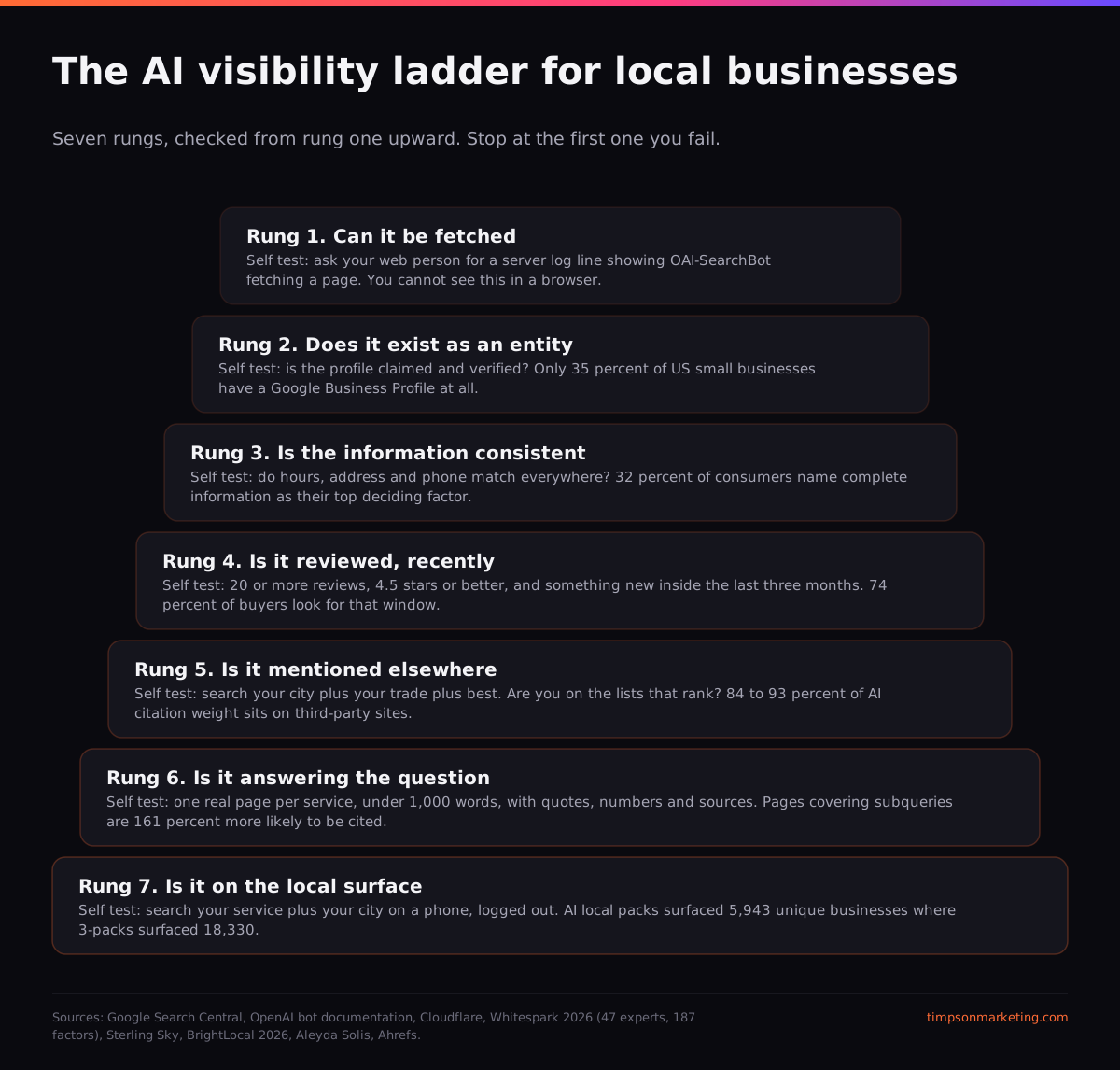
There are seven rungs between your business and an AI recommendation, and they fail in order. Find the lowest one you are failing, fix that, and ignore everything above it.
- AI invisibility is not one problem. It is seven sequential rungs, and work on a high rung does nothing while a lower one is broken.
- The rung nobody can check from a browser is crawler access. OpenAI states that sites opted out of OAI-SearchBot will not be shown in ChatGPT search answers, and firewalls block crawlers that robots.txt allows.
- The rung we believe most owners fail is off-site mentions. Aleyda Solis measured 84 to 93 percent of AI citation weight sitting on third-party sites, and Whitespark's experts scored best-of list placement as the top AI visibility factor.
- Schema markup, llms.txt and Markdown for crawlers have all been tested and produced null or negative results, and Google's own documentation says none of them are required.
- Ranking in the map pack is no longer proof of anything: 28.5 percent of Local Pack businesses were missing from Google's AI Mode for the same query.
You are not imagining it, and it is not one problem
Ask ChatGPT for the best HVAC company in your city and it names two or three businesses. If yours is not one of them, that is the normal outcome, not a punishment.
SOCi tested this at scale in 2026 across nearly 350,000 business locations belonging to 2,751 multi-location brands. ChatGPT recommended 1.2 percent of those locations. Gemini recommended 11 percent. Perplexity recommended 7.4 percent. The same brands appeared in Google's local 3-pack 35.9 percent of the time.
Put those two numbers next to each other. For the same businesses, AI recommendation is roughly thirty times narrower than the local pack. Being left out is the default state, and being included is the exception you have to engineer.
Whether enough of your customers are even asking an assistant in the first place is a separate question, and we worked through what the survey data actually shows about that elsewhere. This post assumes you have already decided it matters and you want to know which specific thing is broken.
AI leaves your business out for one specific reason at a time, and the reasons are not equal. Work up seven rungs in order: can AI systems fetch your site, does your business exist as a verified entity, is your information consistent, are you reviewed recently, are you mentioned on other people's pages, does a page answer the actual question, and are you present on the local surface. Stop at the first rung you fail. Fix that one. Everything above it is wasted money until it passes.
We read the articles ranking for this question today. Not one of them cited a study. Two of them told you to add an llms.txt file, which the largest published test on the subject found is almost never read. All of them handed you a flat list of eight or ten reasons and implied the reasons were interchangeable.
They are not interchangeable, because these failures are sequential. If a crawler gets a challenge page instead of your homepage, your review count changes nothing. If your business has no verified profile anywhere, your blog post about furnace maintenance changes nothing. The rungs stack, and money spent on rung six while rung one is broken is money burned.
Here is the ladder. Check yourself at each rung from the bottom, and stop at the first one you fail.
Rung 1: can an AI system actually fetch your site
This is the rung you cannot check yourself, and it is the one that silently zeroes out everything above it.
Your browser loading your website proves nothing. Browsers run JavaScript, accept cookies, and pass bot challenges. The crawlers that feed AI answers do none of that reliably.
Three things go wrong here. All three are invisible from the front end.
The wrong bot is blocked. OpenAI documents four separate crawlers, and only one of them controls whether you appear in ChatGPT answers. OpenAI's crawler documentation states: "Sites that are opted out of OAI-SearchBot will not be shown in ChatGPT search answers, though can still appear as navigational links." GPTBot is the training crawler. Blocking GPTBot does not remove you from ChatGPT search. Blocking OAI-SearchBot does. Anthropic runs the same three-way split and states that blocking Claude-SearchBot "may reduce your site's visibility and accuracy in user search results." A web person who blanket-blocked "the AI bots" in 2024 to protect your content almost certainly took you out of the answer set at the same time.
The firewall blocks what robots.txt allows. Cloudflare announced in July 2025 that it was "changing the default to block AI crawlers unless they pay creators for their content." Bot protection sits in front of your site and does not read your robots.txt file. Your developer can allow every AI crawler in that text file and the edge will still serve them a challenge page. Nothing about this is visible in any SEO tool you own.
Google's own gate is stricter than owners realize. Google's documentation is explicit: "To be eligible to be shown as a supporting link in AI Overviews or AI Mode, a page must be indexed and eligible to be shown in Google Search with a snippet, fulfilling the Search technical requirements." A stray noindex or nosnippet tag left on a template after a redesign removes those pages from AI features entirely. Google adds that there are "no additional technical requirements," which cuts both ways: nothing exotic is required, but ordinary indexing is not optional.
One more issue is worth knowing about. Vercel and MERJ analyzed server logs across their network and found that no major AI crawler executed JavaScript. GPTBot fetched JavaScript files in 11.50 percent of requests and ClaudeBot in 23.84 percent, and neither ran them. If your site builds its content in the visitor's browser rather than sending it in the HTML, those crawlers see an empty shell. That study is from December 2024 and nobody has replicated it at that scale since, so treat it as strong evidence with a date attached rather than a current measurement.
- Does our robots.txt allow OAI-SearchBot, Claude-SearchBot, PerplexityBot and Googlebot? Paste me the current file.
- Is our firewall, bot protection or CDN challenging or blocking those user agents at the edge, regardless of what robots.txt says? Show me a server log line for one of them from the last 30 days.
- Do our service pages contain their main text in the raw HTML source, and does any template still carry noindex, nosnippet or max-snippet?
If any answer comes back bad, stop reading and fix it. This is usually one afternoon of a developer's time, it costs almost nothing, and it is the reason nobody sells it as a monthly service.
Rung 2: does your business exist as a thing, not just a website
A website is a document. A business is an entity: a name, an address, a phone number, a category, and a list of services, attached to a profile somebody verified.
Most local businesses fail this rung by simply never claiming the asset. BrightLocal surveyed 778 US small business owners and managers and found only 35 percent had a Google Business Profile and only 40 percent maintained a dedicated website, while 89 percent said they invested in organic search. That gap is the whole opportunity in local search, and it has nothing to do with AI.
Google's local ranking documentation says local results are based on relevance, distance and prominence, and adds a line worth repeating to anyone who pitches you: "There's no way to request or pay for a better local ranking on Google."
Here is where we will disappoint you on purpose. Nobody outside Google has documented which local dataset each AI assistant actually queries. OpenAI's crawler documentation never names a third-party index. Perplexity's public documentation describes a search API that returns ranked results but never states whether the index behind it is its own. Every confident article claiming a specific directory is the pipeline into ChatGPT's local answers is repeating a claim that traces back to other blog posts, not to a vendor statement.
So the honest version of this rung is narrower than the pitch you will get. Claim and verify the profiles you can control yourself, starting with Google Business Profile, and treat "we will submit you to the AI directories" as a sales line rather than a product. A profile a human can verify is at least a profile a machine can find. That is the strongest claim the evidence supports, and anyone claiming more is guessing with your money.
Rung 3: does your information agree with itself
When BrightLocal asked 1,227 US consumers who had recently searched for a local business what actually decided which one they contacted, the top answer was not reviews. It was clear and complete information such as hours, address and phone, at 32 percent, ahead of the most or best reviews at 30 percent and clear pricing at 29 percent.
That reorders the usual advice. Getting your hours right beats getting another review, at the point of decision.
Google's guidelines for representing your business are specific and widely ignored. Categories should complete the sentence "This business IS a" rather than "this business HAS a," and Google instructs owners to "use as few categories as possible to describe your overall core business from the provided list." Service areas should not extend "farther than about 2 hours of driving time" from your base. Whitespark's 2026 expert survey scored keyword stuffing your profile description as the single most damaging negative factor of the eight it measured.
Sterling Sky's correlation study across 8,186 businesses in 200 cities found that businesses configured to hide their address showed a negative relationship with local pack rankings. If you have a real shop or yard, show it.
We will not tell you that consistent listings cause AI recommendations. No published study shows that. What is published is that humans rank complete, correct information above reviews when choosing who to call. Fix this rung because it converts, and treat any AI benefit as unproven upside. If an assistant is already stating something false about you, that is a different job with a different fix, covered in what to do when ChatGPT has your details wrong.
Rung 4: are you reviewed, recently, by real people
This is the only rung where the ranking evidence and the buyer evidence point the same direction, which is why we put it above content work.
On the buyer side, BrightLocal's 2026 survey of 1,002 US consumers found 97 percent read reviews, 47 percent will not use a business with fewer than 20 reviews, 31 percent will only use one rated 4.5 stars or better (up from 17 percent the year before), and 74 percent look for reviews written in the last three months.
On the ranking side, Sterling Sky's near me study of 8,186 businesses across 200 cities covered five "near me" service queries and found that the number of reviews received in the current month correlated with local pack position more strongly than lifetime review count. Whitespark's panel of 47 experts scored review recency at number 11 and sustained influx of reviews at number 14 out of 187 factors.
That third number is the one owners miss. The bottleneck is not customer willingness. It is that nobody asks, which is a process problem with a boring fix we have written out step by step in how to get more Google reviews without breaking the rules.
Velocity also explains the thing that drives owners crazy, which is watching a competitor with a third of your review count sit above you. If they got eight reviews last month and you got none, the correlational evidence says that is not an injustice, it is the measurement, and we pull that apart in why a competitor with fewer reviews outranks you.
The AI-specific point is the one almost nobody makes: AI does not replace the review check, it adds a step your reviews have to survive. BrightLocal's research on AI and trust in local search found 97 percent of consumers who use AI for local recommendations at least sometimes double-check those recommendations against real reviews. An assistant naming you is the start of the evaluation, not the end of it. A thin or stale review profile loses the job after the recommendation, which is a worse failure than never being named.
Rung 5: are you mentioned where other people talk
This is the rung we believe most owners fail, and it is the only rung on this ladder that cannot be fixed on your own website.
The hardest number comes from Aleyda Solis, who studied 15 leading SaaS brands across three subverticals using Semrush citation data and Similarweb AI referral data. Her finding: "Across every subvertical and both platforms, third-party sources generate 84% to 93% of citation weight." Between roughly five and six of every seven citations that build a brand's AI visibility sit on somebody else's domain.
The external ecosystem, such as documentation, communities, reviews, publishers, video and peer software sites, needs to be treated as a first-class AI visibility channel with its own strategy and owner, not a promotional afterthought.
Whitespark added an AI Search Visibility column to its ranking factors report for the first time in 2026. The single highest-scoring factor was not on your website at all. It was presence of the business on expert-curated "best of" and similar lists, at 179 points. Second came a dedicated page for each service at 170, and third came prominence on key industry-relevant domains at 167. Two of the top three are off your site.
Ahrefs studied 75,000 brands and found branded web mentions correlated with AI Overview visibility at 0.664, while backlinks managed only 0.218, roughly three times weaker. In a follow-up across ChatGPT, AI Mode and AI Overviews, mentions on YouTube were the strongest correlate measured at about 0.737. Twenty-six percent of those 75,000 brands had zero AI Overview mentions at all.
Peec AI analyzed nearly 200,000 AI responses across eight engines and found that ranking first inside a frequently cited third-party list was associated with a 16.5 percentage point visibility lift in B2B software, and moved brands 1.17 positions earlier in the answer.
So why do we say this is the rung most owners fail? Because it is the only one with no dashboard, no toggle, and no monthly deliverable. It takes months, it happens on other people's websites, and it cannot be demonstrated in a screenshot at the end of the first month. Agencies sell the rungs they can invoice against, which is why you get pitched schema markup and content calendars instead of a plan to get on the "best HVAC companies in Boise" list that already ranks.
The practical version for a service business is unglamorous. Get onto the local "best of" lists that already rank. Get quoted by the local paper on something you genuinely know. Get onto your supplier's dealer locator. Sponsor the youth league that publishes a sponsor page. Answer the question in a video. None of that is exciting and all of it compounds.
## Rung 6: does a page on your site actually answer the question Now, and only now, does what you publish start to matter. Surfer analyzed 10,000 keywords, extracted 33,000 fan-out subqueries and studied 173,902 URLs. Pages that ranked for both the main query and its fan-out subqueries were 161 percent more likely to be cited in an AI Overview than pages ranking only for the main term, at a Spearman correlation of 0.77. Answers are assembled from subquestions, not from head terms. Here is the cross-check nobody has published. In Whitespark's 2026 ranking factors report, "a dedicated page for each service" is the number one local organic ranking factor at 210 points. In the brand new AI Search Visibility column of the same report, that same factor ranks second at 170. It is the only on-site factor sitting near the top of both columns. If you want one structural change that serves classic search and AI answers at the same time, it is a real page for every service you sell, which is the argument we make in more detail about building service and location pages that hold up. Length is not the lever, and there is a mechanism for why. DejanSEO tokenized 2,275 pages across 7,060 queries and 883,262 snippets and found Google allocates a grounding budget of roughly 2,000 words per query across all sources, with each individual source plateauing near 540 words. Coverage fell from 61 percent for pages under 1,000 words to 13 percent for pages over 3,000. A 4,000 word ultimate guide is not being read the way you think it is. The peer-reviewed work agrees on what to put in the words. The KDD 2024 paper that coined generative engine optimization tested nine tactics on a 10,000-query benchmark. Quotation addition scored 27.2, statistics addition 25.2, and citing sources 24.6, against an unoptimized baseline of 19.3. Keyword stuffing scored 17.7, measurably worse than doing nothing at all. That benchmark is from 2023 and the engines have changed, so treat the ordering as the finding rather than the numbers. Quotes, statistics and citations. Precisely the things a busy owner leaves out. ## Rung 7: are you on the surface where the answer gets assembled Ranking in the map pack used to be the finish line. It is now a separate race that shares only part of a field with the AI answer. Sterling Sky analyzed 322 markets and found that "AI local packs featured 5,943 unique businesses whereas, regular 3-packs featured 18,330." In 88 percent of those markets, the AI version surfaced fewer businesses than the traditional pack. Sterling Sky also notes that the AI local packs frequently show one or two businesses instead of three, and carry no call button. A separate study run through the Local SEO Data API across 1,120 searches, seven verticals and 13 US cities in May 2026 found that 28.5 percent of businesses appearing in the traditional Local Pack were missing from AI Mode for the identical query. Comparing only the top three of each, the overlap fell to 48 percent.
Get your GEO Score→AI Mode isn't just the Local Pack with a new coat of paint. It's a separate system that picks businesses its own way.
The synthesis: local pack presence is now necessary and not sufficient. "We rank in the map pack" has stopped being proof that you will be recommended, and any agency still reporting map pack position as the AI visibility metric is reporting the wrong race. It is still the race worth winning first, because it is the one with published mechanics, and the levers that actually move map pack position have not changed as much as the headlines suggest.
The controllable lever on this rung is smaller than most owners expect. Whitespark's experts scored the primary Google Business Profile category as the single highest-impact local pack factor at 227 points, just ahead of proximity of your address to the searcher at 225. One of those you can change this afternoon. The other you cannot change at all. That single dropdown is worth more attention than most owners give it, and choosing the primary category correctly is a twenty minute job with an outsized effect. Being open at the time of the search ranked fifth at 189, which is why after-hours visibility quietly costs service businesses jobs.
One clarification before you go optimizing for "AI." AI Overviews, Google's AI Mode and ChatGPT are three different surfaces with three different selection systems and three different source diets, and treating them as one target is how budgets get wasted. We separated them in AI Overviews versus AI Mode versus ChatGPT.
If you have a business profile that ranks really well, even if you don't see a drop in ranking, your calls from the business profile are going down over time.
What you are being sold that the evidence does not support
Three of the tactics most commonly attached to an AI visibility invoice have been tested and produced nothing.
| The pitch | The published result | |
|---|---|---|
| Schema markup lifts AI citations | Add JSON-LD and get cited more | Ahrefs, 1,885 pages vs 4,000 controls: minus 4.6% in AI Overviews, plus 2.4% AI Mode, plus 2.2% ChatGPT |
| An llms.txt file gets you read by AI | Publish the file so models can find you | Ahrefs, 137,210 domains: 97% of llms.txt files got zero requests in May 2026 |
| Serve Markdown to AI crawlers | Crawlers prefer clean Markdown | Profound, 381 pages over 21 days: no statistically significant increase in AI bot traffic |
| Keyword density still works | Repeat the phrase to signal relevance | KDD 2024 GEO benchmark: 17.7 versus a 19.3 unoptimized baseline, worse than doing nothing |
Google's own guidance on optimizing for generative AI features says the quiet part directly. On structured data: "Structured data isn't required for generative AI search, and there's no special schema.org markup you need to add." On AI files: "You don't need to create new machine readable files, AI text files, markup, or Markdown to appear in Google Search."
Adding schema produced no major uplift in citations on any platform.
Be fair to schema, though. It still earns rich results in classic search and it still helps machines parse your entity, which is a reason to have it. Ahrefs' schema study also states a limitation worth respecting: every page in that study already had 100 or more AI Overview citations before treatment, so the data cannot say what schema does for a page with no AI visibility at all. Our position is that schema is hygiene with real classic-search value and no demonstrated AI citation effect, which is roughly what we argue at greater length in whether schema markup is worth paying for.
SE Ranking reached the same verdict on llms.txt from a different direction, analyzing nearly 300,000 domains and finding that removing the llms.txt variable actually improved the accuracy of their citation-prediction model. A signal that makes a model worse is not a signal.
None of this means the category is fake. It means the honest version of it is much closer to classic search work than the branding suggests, which is the argument in GEO compared with classic SEO, and the question of whether to buy any of it at all is worth asking directly in is AI SEO worth paying for.
How to check yourself without fooling yourself
The single most expensive mistake owners make here is running one prompt, seeing a competitor, and buying something.
SparkToro and Gumshoe.ai recruited 600 volunteers and ran 12 prompts 2,961 times across ChatGPT, Claude and Google's AI. Their finding: "there's a <1 in 100 chance that ChatGPT or Google's AI, if asked 100X, will give you the same list of brands in any two responses."
If you don't like an answer, or your brand doesn't show up where you want it to, just ask a few more times.
That cuts both directions. The screenshot that shows your competitor and not you is noise, and so is the screenshot an agency shows you of your competitor winning. Run the same prompt five times, on different days, logged out, from the city you actually serve, and count how many of the five name you. That number is a signal. One run is not.
Write the count down. A number you recorded yourself, on a date, is the only thing that will let you tell later whether the work is doing anything, and it is the same discipline that separates a real retainer from an activity report, which is the test we lay out in how to tell if your SEO agency is working. If you would rather we ran the baseline with you, that is what the free AI visibility audit is for.
Two more measurement facts belong in your head before anyone quotes you a number. Semrush and Growth Memo found 61.7 percent of AI citations were ghost citations, where a page was used as a source but the brand name never appeared in the answer text, so being cited and being named are different outcomes. And the free first-party tools now exist: Google added generative AI performance reports to Search Console in June 2026, and Microsoft opened an AI Performance report in Bing Webmaster Tools in February 2026. Both are free, which is worth remembering the next time somebody prices an AI visibility dashboard.
We are also not going to pretend anyone can promise you a citation. Nobody controls what a model says, the answers change run to run, and the industry's own leading practitioners say so out loud.
None of the experts have special access to the internal workings of Google's local search algorithm.
What we would do first, in order
Week 1, prove the door is open
Send the three rung-one questions to your web person. Get a robots.txt paste, an edge log line for OAI-SearchBot, and confirmation that service page text is in the raw HTML.
Week 1, establish a baseline
Run five prompts five times each, logged out, from your market. Record how many of 25 runs name you. Screenshot the count, not the answer.
Week 2, fix the entity and the facts
Claim and verify the profile, set one accurate primary category, correct hours, and pull the service area back inside a 2 hour drive.
Week 3, restart the ask
Put a review request into your job-close process so it happens every time. Aim for continuous velocity, not a one-off push.
Week 4, start the slow rung
Build a short list of the "best of" pages, suppliers, associations and local publications that already rank in your market, and start earning a place on them.
Then repeat the baseline measurement in 90 days and compare counts, not screenshots. If the count moved, keep going. If it did not, you are failing a rung lower than the one you have been working on, which is the whole reason to climb this thing in order.
For the layer above this one, the mechanics of how these answers get built are covered in how local businesses rank in AI Overviews and where AI chatbots actually get their data. Each rung on this ladder gets its own full treatment across the rest of the series. If you would rather hand the ladder to someone else, that is what our GEO marketing work is.
Frequently asked questions
Why doesn't ChatGPT recommend my business?
Usually one specific failure, not a general weakness. Check in order: whether crawlers can fetch your site, whether your business exists as a verified profile, whether your details are consistent, whether you have recent reviews, and whether other websites mention you. Stop at the first failure and fix that.
Does schema markup help my business show up in AI answers?
The published evidence says no. Ahrefs tracked 1,885 pages adding JSON-LD against 4,000 controls and measured minus 4.6 percent in AI Overviews. Google's documentation states structured data is not required for generative AI search. Schema still earns rich results in classic search, so keep it for that reason.
Do I need an llms.txt file to be visible to AI?
No. Ahrefs checked 137,210 domains and found 97 percent of published llms.txt files received zero requests in May 2026. SE Ranking analyzed nearly 300,000 domains and found no citation relationship. Google states you do not need AI text files to appear in Search, including its generative features.
How many Google reviews do I need before AI recommends me?
There is no published threshold for AI recommendation. There is one for buyers: BrightLocal found 47 percent of consumers will not use a business with fewer than 20 reviews and 74 percent look for reviews from the last three months. Treat 20 recent reviews as the floor, then keep them coming.
If I rank number one on Google, will AI recommend me?
Not reliably. A study across 1,120 local searches in 13 US cities found 28.5 percent of businesses in the traditional Local Pack were missing from Google's AI Mode for the same query, with only 48 percent overlap in the top three. They are two separate selection systems.
How do I check whether AI crawlers can reach my website?
You cannot check it from a browser. Ask your web person for three things: the current robots.txt, a server log line showing OAI-SearchBot successfully fetching a page, and confirmation that no firewall or CDN rule is challenging AI crawlers at the edge regardless of robots.txt.
How long does it take to start showing up in AI answers?
Nobody can promise a timeline, and answers change between runs. Crawler access fixes take effect as soon as the site is recrawled. Review and third-party mention work compounds over months. Measure by running the same five prompts five times each every 90 days and comparing counts.
Is it worth paying an agency for AI visibility work?
Only if they start at the bottom of the ladder. If the proposal leads with schema markup, an llms.txt file or AI-optimized content, and never mentions crawler access or third-party mentions, they are selling the tactics with published null results and skipping the ones with evidence behind them.
Sources
- Google Search Central. AI Features and Your Website (2025-12)
- Google Search Central. Optimizing your website for generative AI features on Google Search (2026-07)
- OpenAI. OpenAI bots and crawlers documentation (2026-07)
- Anthropic. Does Anthropic crawl data from the web, and how can site owners block the crawler? (2026-04)
- Cloudflare. Content Independence Day: no AI crawl without compensation (2025-07)
- Vercel with MERJ. The rise of the AI crawler (2024-12)
- Whitespark. 2026 Local Search Ranking Factors (2025-11)
- Sterling Sky. The State of Local SEO in 2026 (2026-06)
- Sterling Sky. What gets you ranking for near me searches (2025-11)
- BrightLocal. Local Consumer Review Survey 2026 (2026-02)
- BrightLocal. Consumers, AI and trust in local search (2026-03)
- BrightLocal. Consumer search behavior: channels (2026-07)
- BrightLocal. Consumer search behavior: how people decide (2026-07)
- BrightLocal. SMB Marketing Report 2025 (2025-08)
- Aleyda Solis. SaaS AI search optimization: where citations actually come from (2026-07)
- Ahrefs. Does schema markup increase AI citations? (2026-05)
- Ahrefs. The llms.txt study: 137,210 domains (2026-06)
- Ahrefs. What correlates with AI Overview brand visibility (2025-05)
- Ahrefs. AI brand visibility correlations across ChatGPT, AI Mode and AI Overviews (2025-12)
- Ahrefs. ChatGPT has 12 percent of Google's search volume (2026-02)
- SE Ranking. Is llms.txt worth implementing? A study of 300,000 domains (2025-11)
- Profound. Does serving Markdown increase AI bot traffic? (2026-02)
- Surfer. The impact of query fan-out on AI Overview citations (2025-12)
- DejanSEO. How big are Google's grounding chunks? (2025-12)
- Aggarwal, Murahari, Rajpurohit, Kalyan, Narasimhan, Deshpande. GEO: Generative Engine Optimization (KDD 2024) (2024-06)
- SparkToro with Gumshoe.ai. AIs are highly inconsistent when recommending brands or products (2026-01)
- Semrush with Growth Memo. The ghost citations study (2026-06)
- Semrush. Traffic channel mix study (2026-04)
- Search Engine Land. AI local visibility report 2026 (SOCi Local Visibility Index) (2026)
- Local SEO Data. 28.5% of Local Pack businesses are invisible in Google AI Mode (2026-05)
- Google Business Profile Help. How Google's local ranking works: relevance, distance, prominence (2026)
- Google Business Profile Help. Guidelines for representing your business on Google (2026)
- Google Business Profile Help. Prohibited and restricted content: fake engagement (2026)
- Peec AI. The listicle rank effect: nearly 200,000 AI responses across 8 engines (2026-07)
- Microsoft Bing Webmaster Blog. Introducing AI Performance in Bing Webmaster Tools (2026-02)
- Google Search Central. Search Generative AI performance reports in Search Console (2026-06)
Joseph Timpson has worked in search since 2010 and runs Timpson Marketing out of St. George, Utah. He built The Cited Method, a five stage framework for earning and proving real citations in AI answers, and publishes what does not work alongside what does.
Want this done for you, with the receipts to prove it worked?
One call, no pitch deck. We look at what is actually blocking you and tell you the truth about whether we can help.
Book a free consultation →