AI Overviews, AI Mode and ChatGPT Are Not the Same Thing
Three separate products, three separate source lists, three different things you can be charged for. This page tells you what each one is and deliberately gives you no advice about ranking in them.
- AI Overviews is a summary box Google puts above your normal search results. You do not opt in and Google says it cannot be turned off.
- AI Mode is a separate conversational tab inside Google Search that a person has to click into, at google.com/ai or the AI Mode tab.
- ChatGPT is made by OpenAI, not Google. It has its own crawlers, its own retrieval, and no report you can log into.
- Google's own two AI surfaces cite the same web pages only 13.7 percent of the time, so being in one does not put you in the other.
- Free first-party reporting exists for the two Google surfaces (Search Console) and for Microsoft Copilot (Bing Webmaster Tools). None exists for ChatGPT.
The one number that tells you these are three different products
Google runs two AI answers. Same company, same index, same day, same question. They cite the same web pages 13.7 percent of the time.
Ahrefs' AI Overviews vs AI Mode study got that figure by comparing 540,000 pairs of AI Overview and AI Mode responses to identical queries. The two surfaces agreed on what to say 86 percent of the time. They almost never agreed on who deserved the credit.
Now add ChatGPT, which is not Google at all. Different company, different crawlers, different way of finding a local business.
AI Overviews is a summary box Google places above your normal search results. AI Mode is a separate conversational tab inside Google Search that you have to click into. ChatGPT is a chatbot made by OpenAI, a different company, with its own crawlers and its own way of assembling local results. Appearing in one does not put you in the other two.
This page defines each surface and stops there. There is no ranking advice anywhere in it, which is on purpose. You cannot judge a proposal about something you cannot describe, and every other explainer we read jumped to optimization tactics inside 400 words. If you want the ranking side, that lives in why AI does not recommend your business and in our breakdown of where AI chatbots get their data.
They're two distinct systems that happen to converge on similar conclusions through different paths.
AI Overviews: the box that appears whether you asked for it or not
Google's own description is short. AI Overviews are an "AI-generated snapshot with key information and links to dig deeper," shown "when our systems determine that generative AI can be especially helpful."
You do not opt in. Google states the feature cannot be turned off, though selecting the Web filter after a search returns text links only. On a phone it often fills most of the first screen.
Three facts matter for a local business owner, and they pull in different directions.
It is the highest-volume AI surface by a wide margin. Google said in March 2025 that AI Overviews were used by more than a billion people, and Whitespark's Q1 2025 study found them appearing on an average of 68 percent of local searches.
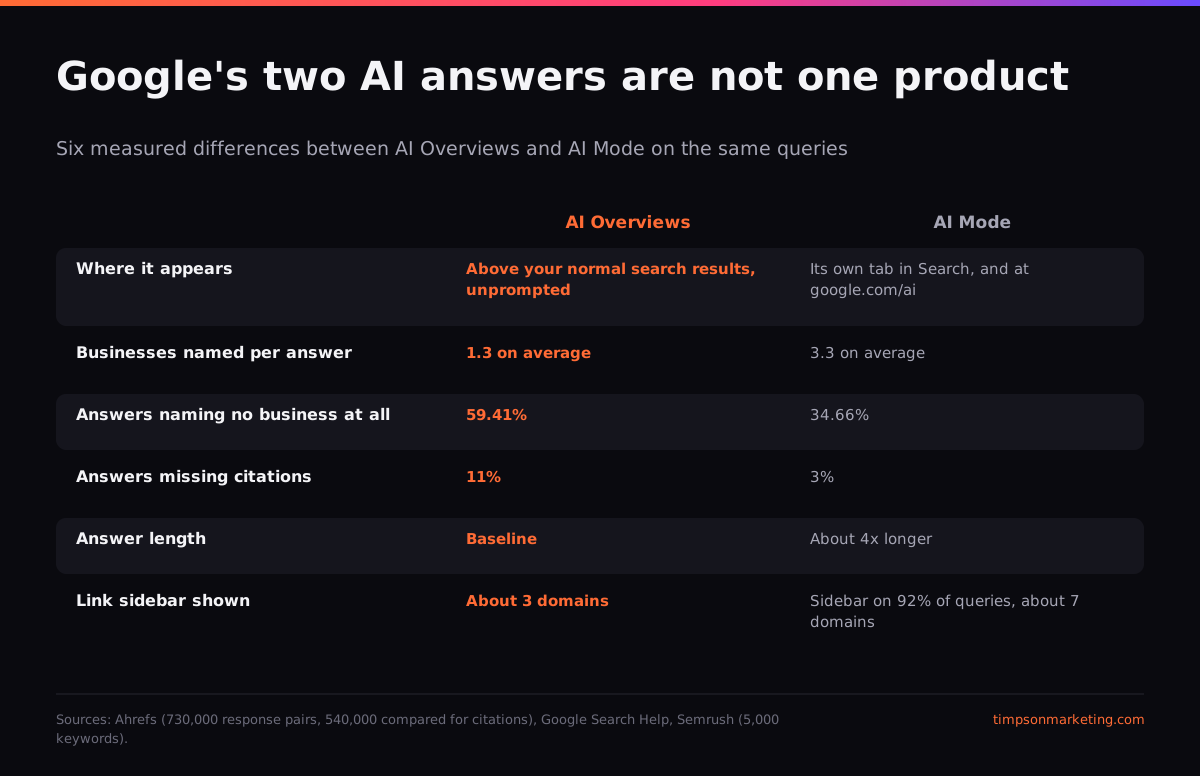
It is also the stingiest about naming anyone. In the Ahrefs comparison, 59.41 percent of AI Overview responses named no brand or business at all, against 34.66 percent for AI Mode. When it does name someone, it averages 1.3 entities per answer.
And it has stopped being a mirror of page one. Ahrefs found in March 2026 that only 38 percent of pages cited in AI Overviews also rank in Google's top 10 for that query, down from roughly 76 percent in its own July 2025 measurement. Anyone still telling you to rank first and let the AI follow is quoting a number that has halved. We covered what that decoupling did to one profession in what AI Overviews did to law firm traffic, and the mechanics in how local businesses rank in AI Overviews.
AI Mode: the tab, not the box
AI Mode is a place you go, not a thing that happens to you. Google calls it "Google's most powerful AI search experience," reachable at google.com/ai, by tapping the AI Mode tab after a search, or from the Google app home screen.
Under the hood it does one thing that explains almost every difference on this page.
AI Mode uses our query fan-out technique, breaking down your question into subtopics and issuing a multitude of queries simultaneously on your behalf.
Your one question becomes many questions. So the answer runs about four times longer than an AI Overview, names more businesses (3.3 entities on average against 1.3), and fails to cite its sources less often (3 percent of responses against 11 percent).
Wider is not automatically better for you. Semrush's 5,000-keyword study found AI Mode showed a link sidebar on 92 percent of queries carrying roughly seven unique domains, against about three in AI Overviews. More slots, but a source list that matched Google's own top 10 only about 54 percent of the time. Extra room is not the same as an extra chance if the room is filled from a different list.
AI Mode is also the only surface here where Google documents personalization in plain language. Personalization is "available if you're 18 or older and have history and personalized recommendations enabled."
Each user may see different AI Mode results for the same query, making prominence hard to track.
That is why the map results your nephew shows you and the ones you see on your own phone can legitimately disagree. It is also why Google Maps ranking and AI Mode visibility have to be tracked as two separate things.
ChatGPT: a different company's product that happens to search
ChatGPT is not a Google feature. OpenAI builds it, and OpenAI reaches the web through its own crawlers, which OpenAI documents by name.
That documentation contains the most useful sentence in this entire subject for a business owner. OpenAI states that "Sites that are opted out of OAI-SearchBot will not be shown in ChatGPT search answers, though can still appear as navigational links." OAI-SearchBot is the crawler that governs whether you can be named. GPTBot, the one most people block on a developer's advice, is for model training and is a separate decision.
On scale, use the census-grade number rather than the vendor one. Pew Research surveyed 5,119 US adults in February 2026 and found 44 percent use ChatGPT against 24 percent for Gemini. BrightLocal found ChatGPT is the most-used AI tool for local business recommendations at 31 percent of consumers, with Google's AI Mode second at 23 percent.
Citation behavior differs again. Semrush's analysis of 126 million prompts found ChatGPT cites an average of 15 sources per response while Gemini cites 3. Being named more often is not the same as being visited more often: Ahrefs estimates Google still sends 190 times more referral traffic to websites than ChatGPT does.
For local questions specifically, Damian Rollison of SOCi documented in May 2025 that ChatGPT runs a Bing search for the query, collects 20 to 30 of the top results, and reorganizes them with its own logic. It was not reading Bing Places, and it does not read your Google Business Profile directly. Worth knowing before anyone invoices you for "ChatGPT listing management," and worth reading alongside whether customers really use ChatGPT to find local businesses and what to do when ChatGPT has wrong information about your business.
Three names people get wrong, including some agencies
Gemini is not AI Mode. Gemini is Google's standalone chatbot app at gemini.google.com. AI Mode is a tab inside Google Search that runs on Gemini models. Same engine, different vehicle, and they behave differently: Gemini averages 3 cited sources per response where ChatGPT averages 15.
ChatGPT Search is not a separate product you can be listed in. It is ChatGPT deciding to run a search. There is no directory, no submission form, and no listing to buy. OpenAI publishes crawler documentation, not a listings program. Anyone selling you a spot is selling you something that does not exist.
And there is a technical trap worth naming plainly, because it is the one thing on this page that can silently zero you out. Google states in its AI features documentation that to appear in either of its AI features, "a page must be indexed and eligible to be shown in Google Search with a snippet." A nosnippet tag left behind by a previous developer removes you from both surfaces at once. That is a statement about eligibility, not a tactic, which is also why the schema markup question and the GEO versus SEO question are separate arguments from this one.
What your business actually shows up as inside each one
Here is the part nobody writes down. In each surface your business is a different object made of different parts.
| Row | AI Overviews | AI Mode | ChatGPT |
|---|---|---|---|
| Made by | OpenAI | ||
| You reach it by | Running a normal search | Clicking the AI Mode tab or google.com/ai | Opening ChatGPT and asking |
| Your business appears as | A name inside the summary text plus a supporting link | A place card with ratings, reviews, photos, hours and action buttons, plus map pins | A listing with name, address and rating, plus map pins |
| Links shown | Yes, supporting links | Yes, plus a sidebar averaging about seven domains | Yes, inline citations |
| Personalized | Not documented as a user setting | Yes, for users 18 and over with history enabled | Yes, if location sharing is on |
| Free owner report | Search Console, impressions only | Search Console, impressions only | None exists |
Two of those rows deserve a warning label.
The AI Mode place card looks like a Google Business Profile because it draws on the same underlying place data. It is not the same result set. Sterling Sky found AI local packs surfaced 5,943 unique businesses against 18,330 in traditional three-packs across the same 322 markets, roughly a third as many winners, with 88 percent of markets showing fewer.
The overall trend here is that businesses are getting less visibility.
Sterling Sky also reports that AI local packs frequently show one or two businesses rather than three, carry no call buttons, and at the time of the report ran on roughly 7 percent of tracked keywords, mobile only, United States only. A surface with no call button is a different commercial object from one with a call button, whatever the map looks like. That distinction is the whole reason we treat AI marketing as separate work from local pack work rather than a rename of it.
## What you can check yourself today, in about fifteen minutes None of this needs a tool subscription. Four of the five checks are free and first-party.
See which surfaces name you→- Search your main service plus your city on a phone, signed out, and note whether an AI Overview appears above the results.
- Tap the AI Mode tab on that same search and compare the businesses it names against the ones in the local pack.
- Open ChatGPT, name your city, ask who the best provider of your service is, and read who it names and what it links to.
- Open Google Search Console and find the Generative AI performance report, which covers AI Overviews and AI Mode.
- Open Bing Webmaster Tools and find the AI Performance report, which covers Microsoft Copilot and Bing AI summaries.
Set your expectations before you open the last two. Google's Search Console report shows impressions, pages, countries and devices. It does not show clicks or the queries behind them, and it counts AI Overviews and AI Mode together in one number rather than splitting them. Microsoft's AI Performance report goes a step further and exposes what it calls grounding queries, meaning the subqueries the AI actually ran.
There is no report at all for ChatGPT. Any vendor showing you a ChatGPT visibility percentage is sampling prompts and estimating from that sample. That is a legitimate method, and it is not a log file, and the difference should be stated out loud on the invoice.
The three questions to ask whoever is selling you this
Most of the confusion in this market is a naming problem, and fixing it costs you one conversation.
"Which surface do you mean?" AI Overviews, AI Mode and ChatGPT are three products with three source lists. The 13.7 percent citation overlap is between two features inside the same company. Across companies the gap is wider still, and a proposal that says "AI" without saying which one has not told you what you are buying. That is the same test we apply in is AI SEO worth paying for.
"What will you show me at the end of the month?" For the two Google surfaces the honest answer is Search Console impressions, with no clicks and no queries. For ChatGPT the honest answer is a sample of prompts, because OpenAI publishes nothing else. Any answer that sounds more precise than that is describing a tool's estimate, not a measurement. More on separating the two in how to tell if your SEO agency is working.
"Does this replace what I already do?" It does not, and the consumer research says so bluntly. BrightLocal's consumer search behavior research found 45 percent of consumers now use AI for local recommendations, up from 6 percent a year earlier. In the same body of work only 18 percent felt ready to contact the business the AI named, and 43 percent of the people who started on AI went to Google afterward to check.
That last pair of numbers is the entire picture in one line. AI is now where a large share of people start and almost nobody finishes. Everything else we publish on this sits in the blog index.
Frequently asked questions
What is the difference between AI Overviews and AI Mode?
AI Overviews is a summary box Google places above your normal search results without you asking. AI Mode is a separate conversational tab you have to click into. Ahrefs compared 540,000 response pairs and found the two cite the same web pages only 13.7 percent of the time.
Is ChatGPT part of Google?
No. ChatGPT is built by OpenAI, a separate company. It reaches the web through its own crawlers, which OpenAI documents publicly, and it assembles local results its own way. Nothing you do inside your Google account affects what ChatGPT says about your business.
Can I turn off AI Overviews for my own searches?
Google states the feature cannot be turned off. You can select the Web filter after running a search, which displays only text-based links without features like AI Overviews. That changes what you see. It does not change what your customers see by default.
Where does AI Mode appear in Google Search?
AI Mode appears as a tab in Search and in the Google app search bar, and it is also reachable directly at google.com/ai. Google describes it as its most powerful AI search experience, with follow-up questions and links to the web.
Do these AI answers show a link to my website?
Yes, all three show links. Google says a page must be indexed and eligible to be shown with a snippet to appear as a supporting link in AI Overviews or AI Mode. Semrush found AI Mode showed a sidebar on 92 percent of queries with about seven domains.
Why do I see different results than my customer on the same search?
Because two of the three surfaces personalize. Google documents AI Mode personalization for users 18 and over with history enabled, and ChatGPT adjusts to shared location and conversation context. Treat any single screenshot as one sample rather than as a ranking position.
How can I see whether I appear in AI answers without buying a tool?
Google Search Console has a Generative AI performance report covering AI Overviews and AI Mode impressions, and Bing Webmaster Tools has an AI Performance report covering Microsoft Copilot. Both are free. There is no equivalent first-party report for ChatGPT, so estimates there come from prompt sampling.
Does ranking number one on Google put me in AI Overviews?
Not reliably any more. Ahrefs analyzed 863,000 keyword SERPs in March 2026 and found only 38 percent of pages cited in AI Overviews also rank in Google's top 10 for that query, down from roughly 76 percent in its own July 2025 measurement.
Sources
- Ahrefs. Are AI Mode and AI Overviews Just Different Versions of the Same Answer? (730K Responses Studied) (2025-12)
- Google Search Help. Get AI-powered responses with AI Mode in Google Search (2026-07)
- Google Search Help. Find information in faster and easier ways with AI Overviews in Google Search (2026-07)
- Google Search Central. AI Features and Your Website (2025-12)
- Google. AI Mode in Google Search: Updates from Google I/O 2025 (2025-05)
- Google. Expanding AI Overviews and introducing AI Mode (2025-03)
- OpenAI. OpenAI bots documentation (2026-07)
- Search Engine Land (Damian Rollison, SOCi). How does ChatGPT conduct local searches? (2025-05)
- Whitespark (Miriam Ellis). Whitespark's Guide to Google's AI Mode for Local Businesses (2026-05)
- Sterling Sky (Joy Hawkins). The State of Local SEO in 2026 (2026-06)
- Google Search Console Help. Generative AI performance report (Search) (2026-06)
- Microsoft Bing Webmaster Blog. Introducing AI Performance in Bing Webmaster Tools (Public Preview) (2026-02)
- Semrush. AI Mode vs AI Overviews vs ChatGPT vs Perplexity: A Comparison Study (2025-07)
- Semrush. Semrush releases expanded 2026 AI Visibility Index analyzing 126 million AI search prompts (2026-06)
- Ahrefs. Only 38% of AI Overview citations rank in the top 10 (2026-03)
- Ahrefs. ChatGPT has 12% of Google's search volume (and Google sends 190x more traffic) (2026-02)
- BrightLocal. Local Consumer Review Survey: AI and Trust (2026-03)
- BrightLocal. Consumer Search Behavior: Channels (2026-07)
- Pew Research Center. Americans and AI 2026: Chatbots, smart devices and views on impact (2026-06)
Joseph Timpson has worked in search since 2010 and runs Timpson Marketing out of St. George, Utah. He built The Cited Method, a five stage framework for earning and proving real citations in AI answers, and publishes what does not work alongside what does.
Want this done for you, with the receipts to prove it worked?
One call, no pitch deck. We look at what is actually blocking you and tell you the truth about whether we can help.
Book a free consultation →